7 Key Benefits of Portfolio Management Software
1. Real-time visibility across all projects
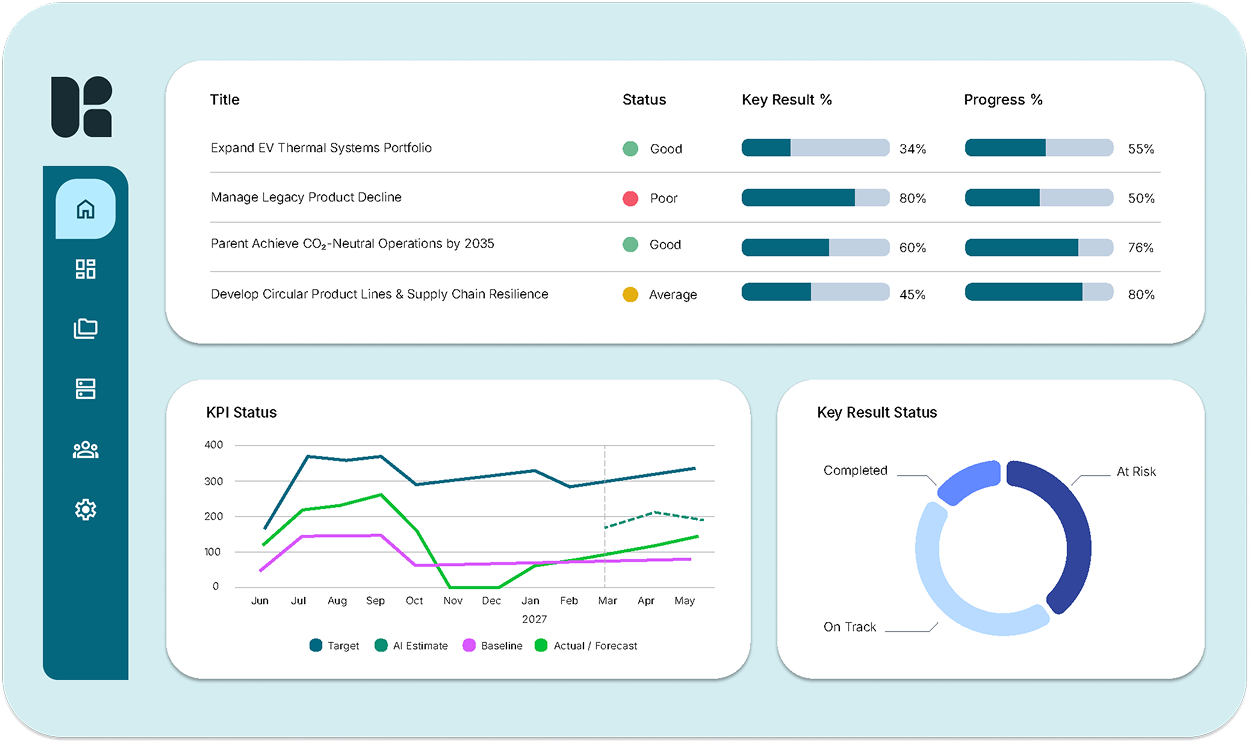
Without a central portfolio view, project status lives in spreadsheets, slide decks, and individual project managers’ heads. Portfolio management software consolidates all of this into a single source of truth. Leaders can see, at any moment, what is on track, what is at risk, what is behind, and what has been completed, without waiting for a weekly report or chasing for updates.
This visibility is particularly valuable for executive stakeholders who need to make resourcing and investment decisions quickly. A portfolio dashboard that reflects current reality, rather than last week’s status update, enables faster and better-informed decisions.
2. Smarter resource allocation
One of the most common causes of project failure is not poor execution but poor resourcing: the wrong people assigned to the wrong work, or the same people overcommitted across too many projects. Portfolio management software provides a consolidated view of resource demand versus supply, making it possible to identify overloads before they cause problems and to model the impact of resource decisions across the whole portfolio.
This is especially important when a new project is proposed. Rather than assessing it in isolation, portfolio software allows you to see exactly what it will take from existing teams and whether that capacity exists.
3. Faster, evidence-based reprioritisation
Priorities change. A new regulatory requirement, a shift in market conditions, or a strategic pivot can make previously important projects less relevant and elevate others. Without portfolio software, reprioritisation is a manual, politically charged process that often drags on far longer than it should.
Portfolio management software enables structured reprioritisation by surfacing all projects with their current scores, dependencies, and resource implications in one view. Decision-makers can model trade-offs, document the reasoning, and communicate changes clearly and consistently, rather than making ad hoc decisions in different conversations with different stakeholders.
4. Improved risk management
Portfolio-level risk is different from project-level risk. A project manager is responsible for the risks within their project. A portfolio manager is responsible for the aggregate risk across all projects: concentration in particular technologies or suppliers, dependencies between projects that create cascading failure risks, or a portfolio so large that no individual project gets sufficient attention to be managed well.
Portfolio management software makes portfolio-level risk visible by consolidating risk ratings, flagging interdependencies, and allowing portfolio managers to assess whether the overall risk profile is within acceptable limits.
5. Alignment with strategic objectives
The most expensive projects in a portfolio are often the ones that should never have been started: work that was approved based on individual business cases without reference to whether the organisation’s strategic priorities had enough projects behind them.
Portfolio management software enables strategic alignment by linking every project to a strategic objective. Portfolio managers can see, at a glance, how investment is distributed across objectives, which priorities are over- or under-resourced, and whether the portfolio as a whole is pointed in the right direction.
6. Stronger stakeholder reporting
Producing a portfolio-level status report manually is time-consuming and prone to error. Information must be gathered from multiple sources, consolidated into a consistent format, and presented in a way that is meaningful to executive stakeholders who do not have time for project-level detail.
Portfolio management software automates much of this process. Standard dashboards can be published on a regular cadence, tailored to different audiences, and updated in real time as project data changes. This reduces the reporting burden on the PMO and improves the quality and timeliness of information reaching decision-makers.
7. Better benefits realisation tracking
Delivering a project on time and within budget is a necessary but insufficient definition of success. The real measure is whether the project delivered the outcomes it promised: the cost saving, the revenue uplift, the productivity improvement, or the risk reduction.
Portfolio management software supports benefits realisation by centralising benefit profiles alongside project status, assigning benefit owners, and tracking realised versus planned benefits at review milestones. This closes the loop between investment and outcome, and builds the organisational discipline to ask, for every project, not just ‘was it delivered?’ but ‘did it work?’