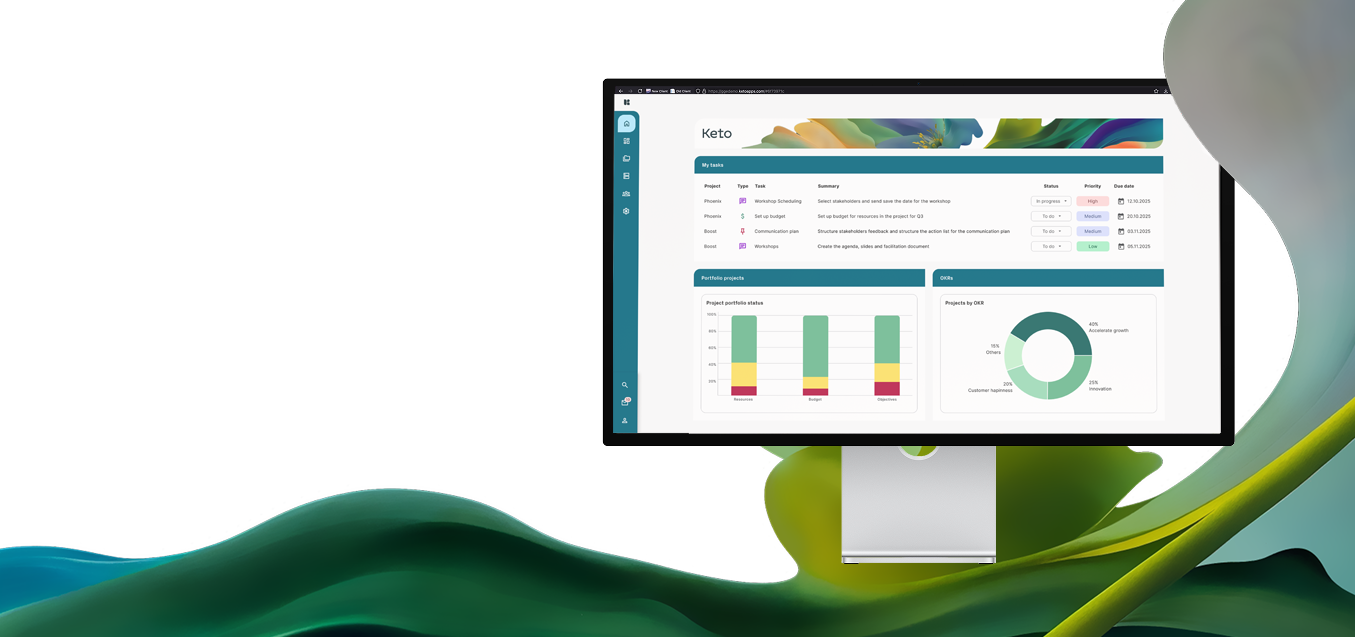
From managing work to steering the portfolio
Jira tracks work and delivery. Keto AI+ helps leaders prioritise initiatives, balance capacity, and steer the portfolio.






Jira is one of the most widely used platforms for tracking and managing work; especially in software, IT, and product teams. It excels at organising tasks, managing backlogs, and coordinating delivery across teams through boards, sprints, and workflows.
Keto AI+ operates at a different level. It’s not built to manage tickets or sprint plans. It helps leadership steer the portfolio: prioritising initiatives, balancing capacity, and making informed trade-offs across strategy, investment, and execution.
Who uses Keto AI+
Why teams consider alternatives to Jira by Atlassian
Execution tracking vs portfolio decisions
Jira is built to manage delivery: tasks, sprints, and team-level progress. But as organisations scale, the challenge shifts from tracking work to deciding what work should happen next. Leadership needs clarity on priorities, trade-offs, and constraints across the portfolio. That’s where execution tools start to fall short.
Backlogs and sprints vs initiative portfolios
Jira structures work through issues, backlogs, and releases, with planning flowing from teams upward. This works well for delivery, but less so for shaping portfolio direction. Organisations need a view of initiatives, investments, and strategic priorities, so they can decide what moves forward, not just how work is executed.
Keto takes a different approach. Rather than focusing on aggregating execution systems, it focuses on portfolio prioritisation, alignment, and scenario-driven decisions across initiatives.
The emphasis is not on administering work plans, but on making better portfolio trade-offs.
Agile coordination vs portfolio flow
Jira can coordinate work across teams and manage dependencies at program level. But portfolio challenges often go beyond coordination. Leaders need to understand how initiatives interact, where capacity is constrained, and how priorities impact the system as a whole. This requires a portfolio flow perspective, not just delivery alignment.
Keto focuses more directly on alignment between strategy, capacity, and investments. Its strength is helping leadership see how initiatives interact across the portfolio so that priorities can shift as conditions change.
Workflow control vs decision support
Jira is strong at enforcing workflows: statuses, transitions, and automation ensure work follows defined processes. But governance at portfolio level is different. It requires decision points, prioritisation, and trade-offs across initiatives. Organisations need support for choosing what to start, delay, or stop, not just managing how work progresses.
Keto focuses on decision support, including prioritisation models, scenario views, and visibility into capacity bottlenecks across the portfolio.
The goal is not just to report on the portfolio, but to continuously steer it.
Keto vs. Jira by Atlassian
Keto AI+
Jira (Atlassian)
Switching made simple, not stressful
What you leave behind
With Keto
With Jira
What Keto AI+ unlocks
Portfolio-level clarity
See how strategy, initiatives, risks, and capacity interact across the portfolio.
Better prioritisation decisions
Evaluate initiatives using structured scoring models and scenario comparisons.
Capacity-aware planning
Identify resource bottlenecks before they slow the entire organization.
Faster strategic adaptation
Rebalance investments and initiatives as conditions change.
Jira manages delivery. Keto drives decision on portfolio.
Both platforms solve real problems.
The difference is whether your organisation needs to execute work better, or decide what work should happen next.