

Clarity PPM: Your time capsule from the 2000s

Clarity PPM users realized…
Clarity PPM has earned its place in the enterprise portfolio management world. For decades, it helped PMOs and IT leaders stay on top of project status, costs, and governance. It’s a familiar system, often deeply embedded and well-understood.
Several enterprise transformation leaders we’ve spoken with describe the same pattern: Clarity PPM works, until the portfolio starts to move.
But over time, something changes.
And when it breaks, it breaks hard. The shift from tolerance to frustration often happens quietly, until teams speak plainly about the pain.
What leaders told us after leaving Clarity PPM:
“Clarity had become this hard-coded maze of custom setups. It took more time to manage the system than to manage the portfolio.”
“It was so clunky we gave up and went back to Excel. At least Excel didn’t fight us every step of the way.”
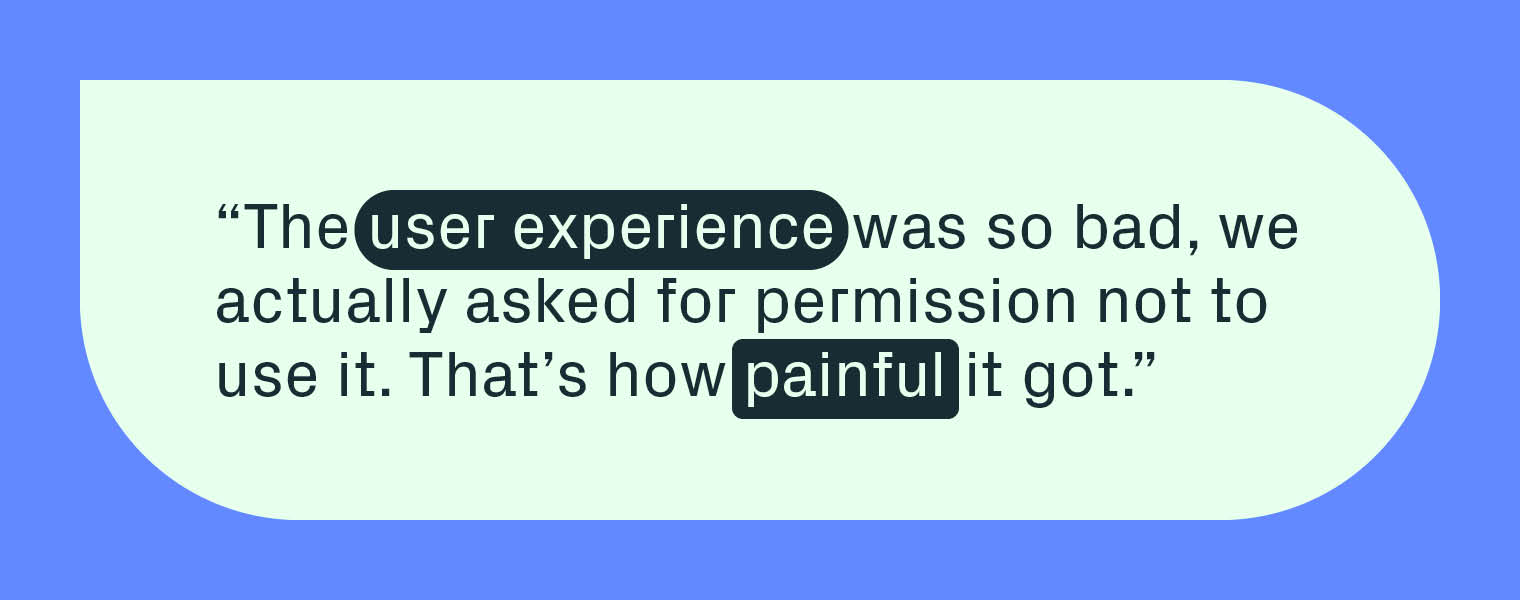
“The user experience was so bad, we actually asked for permission not to use it. That’s how painful it got.”
Leaders begin to notice:
- Important impact questions still end up in Excel.
- Scenario planning lives in PowerPoint.
- Critical decisions rely on hallway conversations and instinct.
They realize:
- Clarity PPM is solid for tracking and reporting.
- But it struggles to support real-time decisions.
- The tool records what happened, it doesn’t help explain what to do next.
Some even reflect that what once felt like control has turned into constraint. Project managers spend more time translating requests into system language than facilitating action. When strategic pivots occur, leadership teams often find themselves back in spreadsheets and slides, manually stitching together what the system can’t.
There is no single moment of disillusionment. It creeps in. A leadership offsite where no one uses Clarity PPM outputs. A quarterly review where impact analysis is done by hand. A budgeting season where resource trade-offs feel like guesswork. That’s when it becomes clear: the issue isn’t the configuration, it’s the model.
And it’s not just anecdotal. In a Forrester study, 58% of strategy execution leaders said their current tools make it hard to adjust to new priorities. Many legacy systems were built around linear delivery models, not dynamic, multi-speed portfolios.
Why Clarity PPM works, until it doesn’t
Clarity PPM was built for a world where strategy was steady, governance was centralized, and change came in manageable waves.
Its design reflects that era:
- Annual planning cycles
- Predictable delivery patterns
- Clear approval checkpoints
- Heavy configuration to reflect known processes
These strengths still serve some contexts well. Stable environments. Compliance-heavy portfolios. Highly regulated industries. For reporting and audit trails, Clarity PPM can shine.
But today’s enterprise landscape doesn’t stay still.
Now, portfolios shift monthly. New initiatives emerge from regulatory shocks, market opportunities, or executive pivots. Resources are scarce and specialized. Business cases compete. And plans change often, fast.
This creates a mismatch:
- Linear tools in a looping world
- Governance-centric design in a decision-centric reality
- Systems built for what was, not what is becoming
Clarity PPM, like many legacy PPM tools, becomes a record of yesterday’s plan. It tells you where you were. But it doesn’t show where to go next.
In today’s strategic environment, stability has been replaced by movement. What used to be edge cases: M&A integrations, regulatory responses, shifting workforce priorities ,are now common. Portfolios are dynamic by default.
And when motion becomes the norm, tools built for stillness can become friction points.
Organizations that once valued predictability now prize resilience. And that requires systems that don’t just report on change but move with it.
Why PPM tools fail to bridge strategy and execution in real time
Most traditional enterprise PPM tools, Clarity PPM included, treat strategy, planning, and execution as separate zones.
- Strategy is defined once a year.
- Planning happens in cycles.
- Execution is tracked against the plan.
But today’s reality is more fluid.
- Leadership needs to pivot fast.
- Portfolios must reflect both ambition and constraints.
- Resource shifts happen mid-cycle.
And most importantly, the data arrives late. By the time leadership sees the update, the decision has already been made elsewhere.
The result?
- Lagging indicators dominate.
- Reporting becomes reactive.
- Strategy and execution drift apart.
This disconnection creates political tension. Teams debate priorities without shared facts. PMOs act as translators between planning outputs and boardroom inputs. Everyone is working, but few can say with certainty that the work aligns with strategic goals.
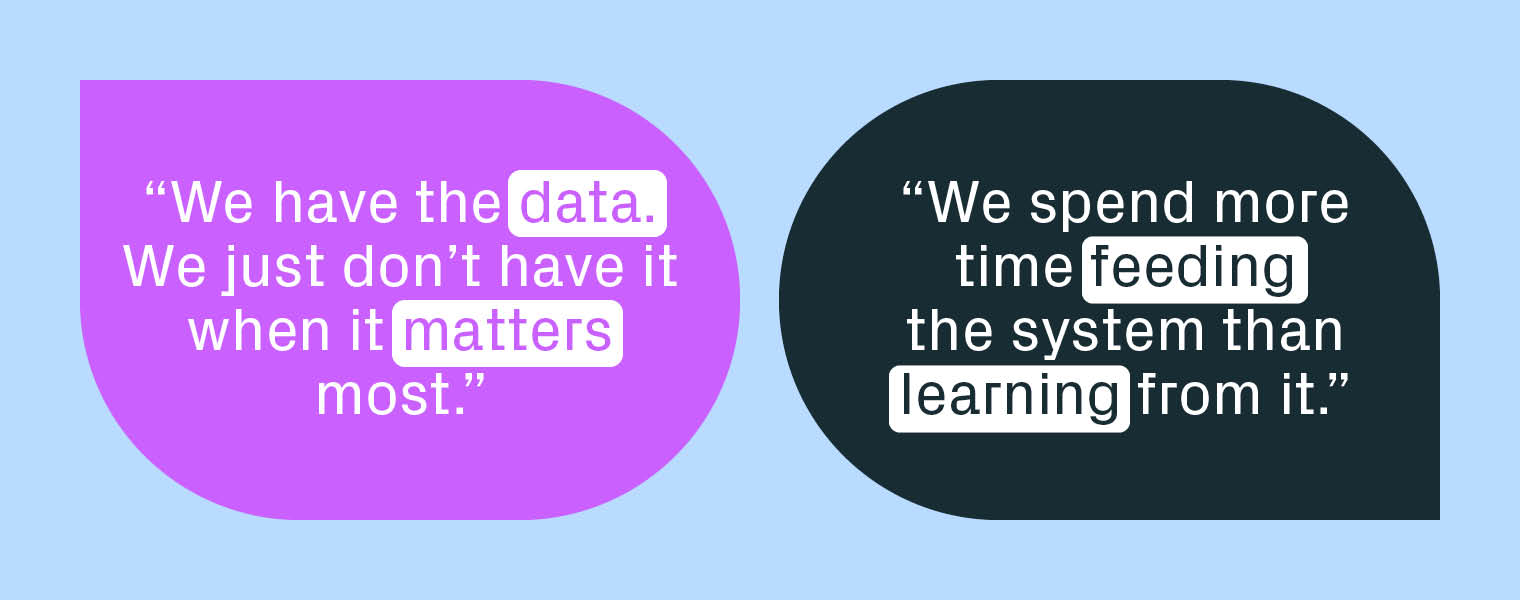
A portfolio leader put it plainly: “We have the data. We just don’t have it when it matters most.”
What’s missing is a living link between strategy and execution. A shared view that keeps pace with real-time change. A way to see the implications of choices before they are made, not weeks later, when slide decks are reviewed.
Without this bridge, enterprise leaders are left navigating by instinct instead of insight.
According to McKinsey, companies that can quickly reallocate resources to strategic priorities are more than twice as likely to outperform peers. That kind of agility can’t happen if strategy lives in one tool and execution in another.
Why cost & complexity grow faster than value
Over time, the effort to keep Clarity PPM valuable becomes a strategy in itself.
- Configuration becomes customization.
- Admins multiply to maintain quality.
- Non-PMO users resist engagement.
Leaders quietly admit:
“We spend more time feeding the system than learning from it.”
Implementation and support costs rise, but real decision-making remains elsewhere ,in slide decks, spreadsheets, and backchannel chats.
The investment keeps growing. But the return? Harder to measure.
And there’s another layer: as the system grows more complex, so does the training burden. Institutional knowledge becomes tribal. New team members struggle to onboard. The system evolves into a tool for the few, not the many. This erodes trust. Overhead becomes inertia.
Ironically, the attempt to create a single source of truth often results in fragmented truths, because the questions leaders need to ask can’t be answered inside the tool.
What begins as a sensible investment in structure becomes a high-effort attempt to stay afloat in a sea of change.
The tipping point often comes when finance and transformation leaders ask, “What’s our total cost to maintain this platform?” And the honest answer is uncomfortable.
When configuration doesn’t equal adaptability
Clarity PPM offers significant configuration options. But configuration is not the same as adaptability.
- You can create custom fields ,but they only help if the question is already known.
- You can build workflows ,but only for predictable routes.
- You can generate reports ,but not easily simulate impact.
When a new initiative lands, or a leadership shift resets priorities, organizations often default to manual tools to understand the implications. Clarity PPM isn’t built to flex fast.
That’s when the illusion of flexibility becomes clear.
Configuration is a promise to handle complexity through setup. Adaptability is the ability to respond without friction. Clarity PPM excels at the first. But strategic execution demands the second.
Time and again, we hear:
“The system does what we told it to do. The problem is, we’re not asking the same questions anymore.”
The difference matters. Because in a modern environment, change doesn’t ask for permission. It arrives with urgency. The ability to ask, “What if?” and model the ripple effects across funding, capacity, and outcomes. That’s not a nice-to-have. It’s a survival skill.
Without that capability, even well-configured systems become bottlenecks.
Why Enterprise PPM is no longer enough
Enterprise project management still matters. Delivery still matters. Governance still matters.
But managing projects is not the same as managing decisions.
Modern organizations need:
- Portfolio-level visibility
- Data that supports strategic conversations
- Tools that help translate intention into impact
They need to see:
- What shifts if priorities change?
- Where is value being created or lost?
- How do constraints shape the path forward?
These are the questions executive teams are asking. Not “Are we on track?” , but “Are we making the right calls?”
The future of strategic execution isn’t about tighter control. It’s about better alignment.
It’s about:
- Seeing sooner
- Deciding faster
- Moving together
It requires tools that behave like the business: dynamic, real-time, connected.
And so, the real question isn’t whether Clarity PPM is bad. It’s whether it matches how your organization actually operates today.
If your portfolio is in motion, if your leadership is asking value-focused questions, if your teams are responding to constant change, then it may not be about fixing the tool.
It may be about outgrowing the model.
A final reflection
The pressure on strategic leaders is only growing. From digital transformation to ESG reporting, from regulatory compliance to workforce upskilling , the pace, scale, and variety of demands have accelerated. Static planning tools struggle to keep up.
Enterprise PPM, in its original form, was never designed for this level of volatility. It served a different era. And while it still provides value, it may no longer be enough on its own.
So ask yourself:
- Do our tools serve our current reality, or a past one?
- Are we optimizing for reporting, or for resilience?
- Is the portfolio a reflection of strategy, or a record of tasks?
Because staying still isn’t neutral. In a world that moves, staying still is falling behind.
Does your tool reflect how your organization actually works today?
Or are you still trying to steer change with a system built for stillness?